




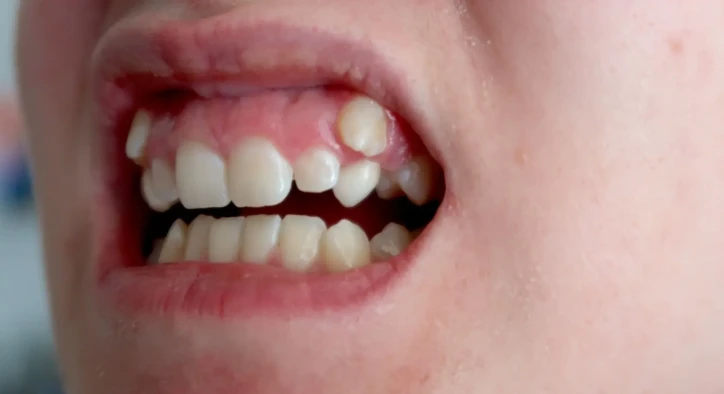

Canine teeth (eyeteeth) serve as the structural pillars of the dental arch, guiding jaw movement and defining the cornerstone architecture of a symmetrical smile. However, because maxillary canines develop high in the jawbone and possess the longest root pathway during eruption, they are the second most commonly impacted teeth after wisdom teeth. Addressing impacted canine teeth is a critical clinical challenge: when a canine fails to erupt through the gum line and remains trapped inside dense bone, it risks resorbing adjacent incisor roots and collapsing bite stability.
For teenage and adult patients facing an un-erupted canine or a retained primary tooth, understanding what causes impacted canine teeth is the first step toward effective intervention. Modern multidisciplinary dentistry provides proven pathways ranging from surgical exposure combined with impacted canine teeth braces to advanced adult implant replacements. This clinical guide explores the primary diagnostic workflows, outlines how to execute surgery for impacted canine teeth, compares surgical traction against removal of impacted canine teeth, evaluates options for impacted canine teeth in adults, and explains whether how to fix impacted canine teeth without braces is clinically viable.
Table Of Contents
- What Causes Impacted Canine Teeth and How Are They Diagnosed?
- What Are the Clinical Options for Impacted Canine Teeth Treatment?
- Can You Fix Impacted Canine Teeth in Adults and Can You Do It Without Braces?
- Structural Evaluation: Impacted Canine Teeth Before and After Rehabilitation
- Frequently Asked Questions
- Is surgery for impacted canine teeth painful?
- What happens if you leave an impacted canine tooth untreated?
- How long does it take to pull an impacted canine into place with braces?
- When is removal of impacted canine teeth better than trying to save the tooth?
- Can clear aligners (like Invisalign) be used for impacted canine traction instead of traditional braces?
What Causes Impacted Canine Teeth and How Are They Diagnosed?
To understand why a canine becomes trapped beneath bone or soft tissue, clinicians examine both genetic and mechanical factors. When evaluating what causes impacted canine teeth, orthodontists identify several primary developmental triggers:
- Inadequate Arch Space (Crowding): Insufficient room along the jawbone prevents the thick canine crown from finding an eruption pathway.
- Ectopic Eruption Pathway: The tooth bud forms at an unusual angle, causing the canine to travel palatally (toward the roof of the mouth) or labially (toward the lip) instead of straight down.
- Retained Primary Canines: Baby canines that fail to shed naturally act as physical barriers, blocking the permanent tooth below.
- Supernumerary Teeth or Cysts: Extra teeth buds or developmental cysts physically obstruct the erupting tooth root path.
- [ CBCT 3D VOLUMETRIC SCAN ]: Precise depth, angle, and root proximity mapping
- [ SURGICAL EXPOSURE ]: Window created through bone/gum to reach tooth crown
- [ BONDING ORTHODONTIC BUTTON ]: Attachment of a traction chain directly to enamel
- [ CONTROLLED CROWN TRACTION ]: Gentle, directional force bringing canine into arch line
Accurate diagnosis relies on 3D Cone Beam Computed Tomography (CBCT) scanning. CBCT imaging provides a true 3D spatial map of the tooth crown, confirming whether it sits palatally or labially and ensuring traction forces will not damage the roots of neighboring central or lateral incisors.
What Are the Clinical Options for Impacted Canine Teeth Treatment?
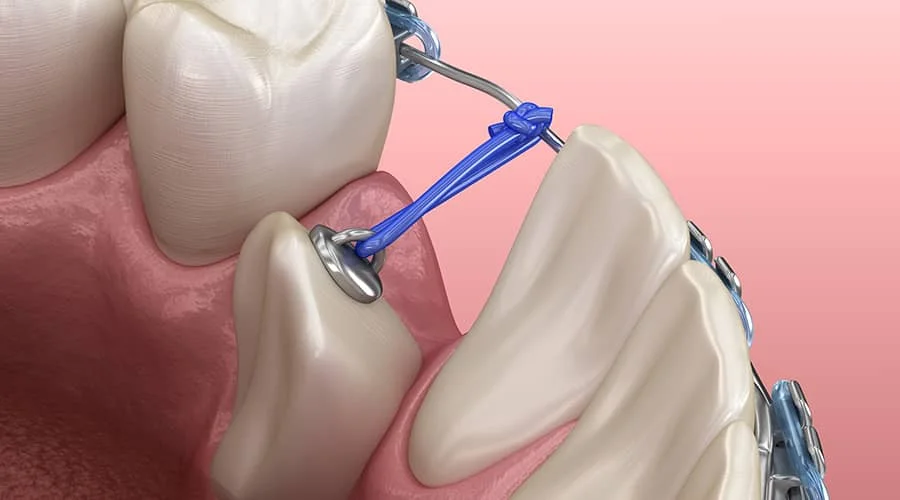
Selecting the optimal impacted canine teeth treatment depends on patient age, tooth depth, angle of impaction, and overall arch integrity.
1. Surgical Exposure and Orthodontic Traction (Gold Standard)
The primary method to guide the natural tooth into position involves surgery for impacted canine teeth combined with braces. An oral surgeon creates a small window in the gum and bone, bonds a tiny gold bracket with a micro-chain to the crown, and closes the site. The orthodontist then applies light, continuous tension to the chain using impacted canine teeth braces, slowly pulling the hidden canine into its correct position over 12 to 24 months.
2. Surgical Extraction and Implant Replacement
When a canine is severely ankylosed (fused to the jawbone), inverted, or actively resorbing neighbor roots, removal of impacted canine teeth becomes necessary. Following extraction, the space is rehabilitated using a dental implant or a custom bridge, permanently stabilizing the bite.
Can You Fix Impacted Canine Teeth in Adults and Can You Do It Without Braces?
Managing impacted canine teeth in adults presents unique biological considerations compared to adolescent treatment. As bone density increases with age, the rate of tooth ankylosis rises, making orthodontic traction more challenging in older patients.
Patients frequently ask how to fix impacted canine teeth without braces. Clinically, bringing an impacted tooth physically through bone into alignment without fixed orthodontic appliances or clear aligner traction is impossible. However, "fixing" the appearance without braces can be achieved through alternative strategies:
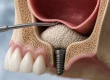
- Surgical Extraction + Dental Implant: The trapped tooth is extracted surgically, and a premium titanium implant and monolithic zirconia crown are placed directly into the gap without moving surrounding teeth with braces.
- Cosmetic Reshaping of Retained Baby Tooth or Premolar: If the impacted canine is deep and asymptomatic, it can be left monitored in the bone while the retained primary tooth or adjacent first premolar is aesthetically reshaped with E-Max porcelain veneers or crowns to mimic a permanent canine.
Structural Evaluation: Impacted Canine Teeth Before and After Rehabilitation
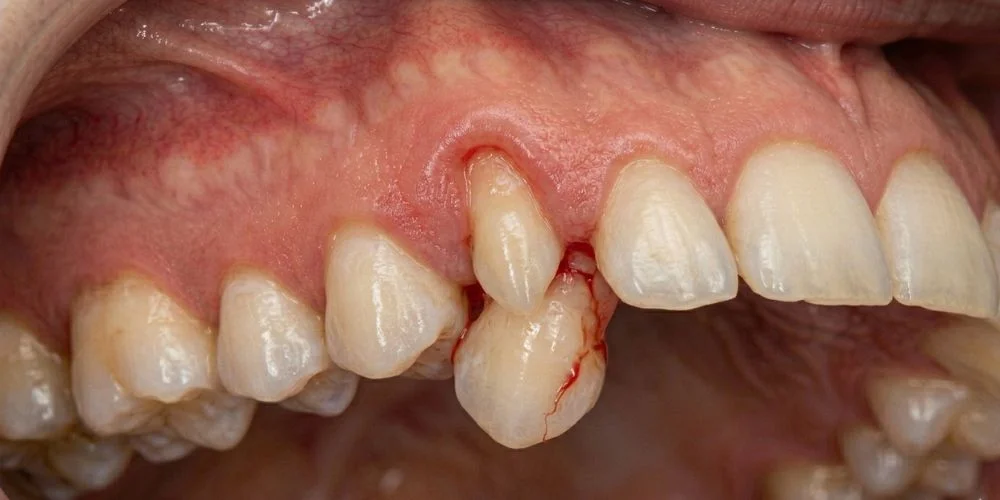
Comparing typical impacted canine teeth before and after treatment outcomes demonstrates how proper canine positioning improves both smile geometry and joint function.
Evaluation Metric | Pre-Treatment Impacted State | Post-Treatment Restored Architecture |
Canine Guidance & Occlusion | Absent; high risk of premature wear on premolars | Restored canine rise; protected lateral bite movement |
Arch Aesthetics & Symmetry | Gap, retained baby tooth, or misaligned premolar | Full 3D smile symmetry with natural canine contours |
Adjacent Root Health | Risk of resorption on lateral incisor roots | Adjacent roots stabilized; no physical pressure |
Alveolar Bone Volume | Deficient in empty arch segment | Maintained through natural root presence or implant |
Frequently Asked Questions
Is surgery for impacted canine teeth painful?
No. The exposure procedure is performed under local anesthesia or IV sedation, making it completely painless. Post-operative discomfort is mild to moderate and easily managed with prescribed anti-inflammatory medications for 3 to 5 days.
What happens if you leave an impacted canine tooth untreated?
Leaving an impacted canine unmanaged can cause the trapped crown to resorb (eat away) the roots of neighboring healthy teeth. It can also form dentigerous cysts inside the jawbone, cause arch crowding, or lead to premature loss of the primary canine.
How long does it take to pull an impacted canine into place with braces?
Once the tooth is surgically exposed and a traction bracket is bonded, bringing the crown down into the arch typically takes between 12 and 24 months, depending on how deep the tooth is buried in the jawbone.
When is removal of impacted canine teeth better than trying to save the tooth?
Extraction is preferred if the canine is ankylosed (fused to bone), positioned horizontally across neighboring roots where movement would destroy healthy teeth, severely decayed, or if the patient is an adult seeking a faster solution via dental implants.
Can clear aligners (like Invisalign) be used for impacted canine traction instead of traditional braces?
Yes, in select cases. While fixed metal or ceramic braces offer superior multi-directional rotational control during initial traction, modern clear aligner systems combined with auxiliary buttons and elastics can guide an exposed canine into position once it clears dense bone.
About the Author