





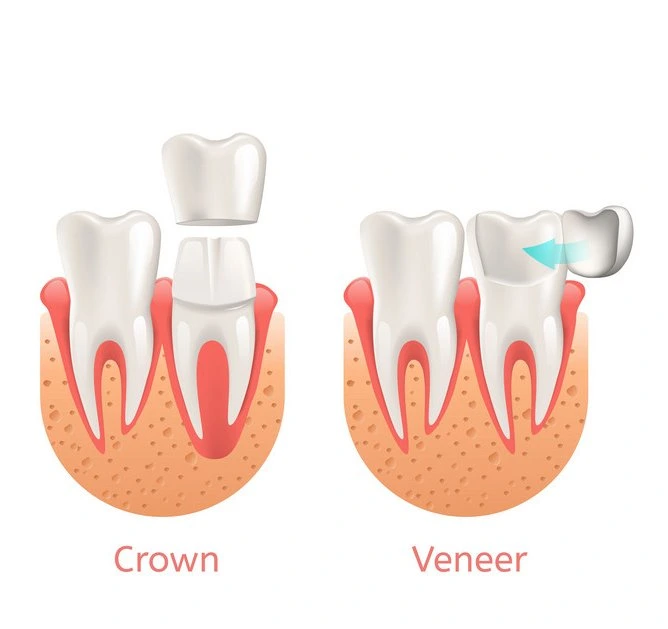
Anyone who asks a dentist about improving the look of a damaged or discoloured tooth will soon hear two words: veneers and crowns. Both can change the shape, length and colour of a tooth, and both are often made from porcelain, so it is easy to assume they are the same treatment under different names. They are not. A veneer covers the front of a tooth, while a crown covers the whole tooth, and that single difference affects how much of your natural tooth is removed, how strong the result is and which problems each one can solve.
This guide explains veneers vs crowns in plain language. It describes what each restoration is, how the preparation differs, when one is usually preferred over the other, how long they last and which factors influence the price. It is general information, and the right choice for you can only be confirmed after an examination.
Table Of Contents
- Veneers vs Crowns: What Is the Difference?
- What Are Dental Veneers?
- What Are Dental Crowns?
- How Much Natural Tooth Is Removed?
- When Veneers Are the Better Choice
- When Crowns Are the Better Choice
- Veneers vs Crowns: Side by Side
- Materials: Porcelain, Zirconia and Composite
- Lifespan and Maintenance
- Veneers vs Crowns Cost: What Affects the Price
- How to Choose Between Veneers and Crowns
- Frequently Asked Questions
Veneers vs Crowns: What Is the Difference?
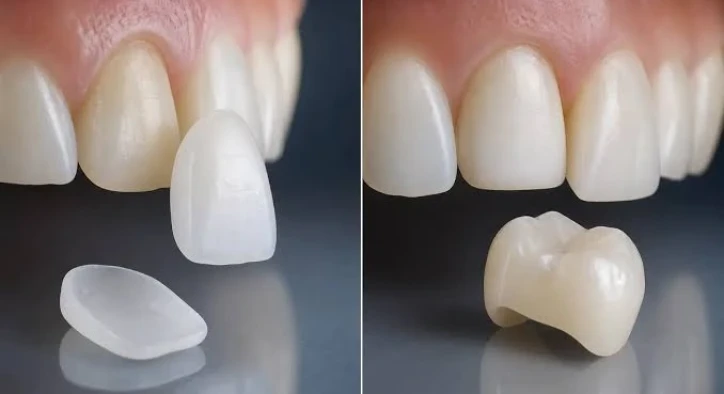
A veneer is a thin shell, usually between half a millimetre and one millimetre thick, that is bonded to the front surface of a tooth. It improves how the tooth looks but relies on the remaining natural tooth for strength. A crown, sometimes called a cap, is a hollow restoration that fits over the entire visible part of the tooth, front, back, sides and chewing surface. It rebuilds the tooth from the outside and protects what is left inside.
Because of this, the two treatments answer different questions. Veneers are mainly a cosmetic solution for teeth that are structurally sound but look discoloured, slightly misshapen, chipped or gapped. Crowns are mainly a protective and restorative solution for teeth that are heavily decayed, cracked, weakened by a large filling or treated with a root canal. Some cases overlap, and that is where careful planning matters most.
What Are Dental Veneers?
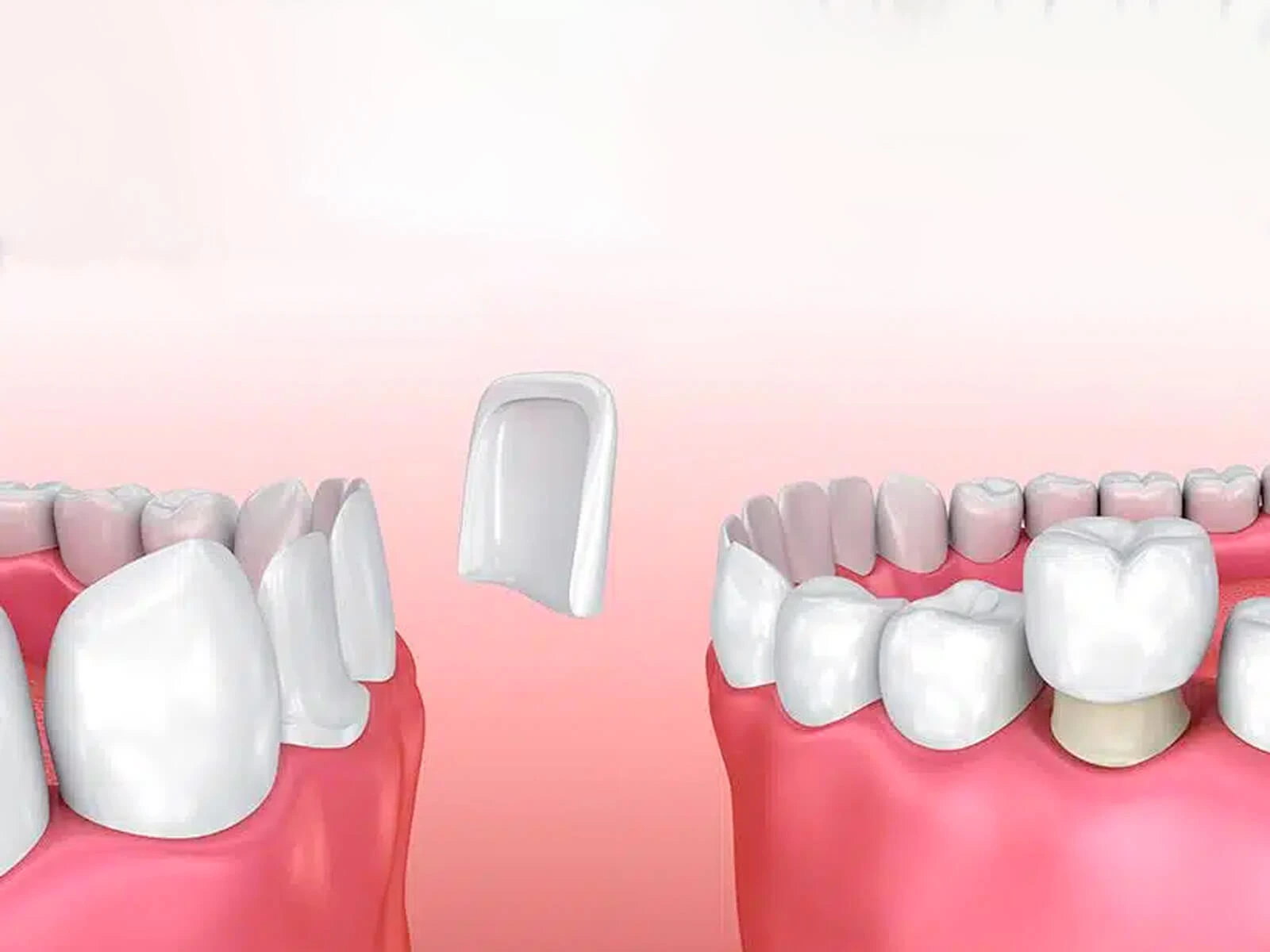
Dental veneers are custom made shells of porcelain, ceramic or composite resin. They are fitted to the visible side of the front teeth, which is why they are most common in the smile zone. A veneer can lengthen a short tooth, close a small gap, mask stubborn staining that whitening cannot remove and even out minor irregularities in shape.
Preparation usually involves removing a thin layer of enamel from the front of the tooth so that the veneer sits flush with its neighbours. Some thinner designs need little or no reduction, but they suit only selected cases. Once bonded, a veneer becomes part of the tooth surface, and the result looks natural when the shape, shade and translucency are chosen with care. Since the enamel layer cannot grow back, most dentists treat veneer preparation as a permanent decision.
What Are Dental Crowns?
A dental crown is a full coverage restoration. It can be made of porcelain, zirconia, porcelain fused to metal or metal alloys, and the choice depends on the position of the tooth and the forces it must handle. Crowns are used to protect a cracked tooth, restore a tooth with a very large filling, cover a tooth after a root canal treatment, support a dental bridge or sit on top of an implant.
To make room for a crown, the dentist reduces the tooth on all sides, usually by one to two millimetres depending on the material. A temporary crown protects the tooth while the final one is made. Once cemented, the crown holds the remaining tooth together and spreads chewing force over the whole structure, which is why it is the more dependable choice when a tooth is weak.
How Much Natural Tooth Is Removed?
This is often the deciding question. With a veneer, preparation is limited to a thin layer on the front surface and the edge, so most of the tooth stays intact. With a crown, the tooth is reduced all the way around, which removes considerably more structure. Dentists generally try to preserve natural tooth wherever possible, because every millimetre that is removed is gone for good and can make future treatment more complicated.
This does not mean crowns are a poor choice. When a tooth is already broken down, much of that structure is lost anyway, and a crown protects what is left. The principle is simple: choose the least invasive option that solves the problem safely and lasts long enough. A veneer on a tooth that actually needs the strength of a crown may chip or loosen, while a crown on a healthy tooth that only needed a veneer removes tooth that did not have to be removed.
When Veneers Are the Better Choice
Veneers are usually the better option when the tooth is healthy but the appearance is the main concern. Typical situations include:
- Stains or discolouration that do not respond to professional whitening.
- Small chips or worn edges on otherwise strong front teeth.
- Minor gaps between front teeth.
- Slightly uneven shape, size or length of visible teeth.
- A wish to change the overall look of the smile with a conservative approach.
Veneers also need healthy gums and enough enamel for bonding. People who grind or clench their teeth heavily may need extra protection, such as a night guard, because strong forces can crack porcelain. A dentist will check your bite before recommending veneers.
When Crowns Are the Better Choice
Crowns are usually the better option when the tooth has lost significant structure or needs protection that a thin shell cannot provide. Typical situations include:
- Deep decay that leaves too little healthy tooth for a filling.
- A cracked or fractured tooth.
- A tooth that has had a root canal and is more brittle.
- A very large old filling that is failing.
- A tooth that must carry a bridge or an implant restoration.
Back teeth, which take the strongest chewing forces, are more often restored with crowns than with veneers. Even on front teeth, a crown may be recommended if the tooth is badly damaged. The dentist decides based on how much healthy tooth remains and how the tooth is used.
Veneers vs Crowns: Side by Side
The table below summarises the main differences. It is a general comparison, and individual cases vary.
| Feature | Veneers | Crowns |
|---|---|---|
| Coverage | Front surface of the tooth | Whole visible part of the tooth |
| Main purpose | Cosmetic improvement | Protection and restoration |
| Tooth removal | Thin layer of enamel | Reduction on all sides |
| Best for | Healthy teeth with colour or shape concerns | Weak, cracked, decayed or root treated teeth |
| Strength | Depends on the tooth beneath | Supports and protects the whole tooth |
| Typical use | Front teeth in the smile zone | Front and back teeth |
| Reversibility | Generally permanent after enamel removal | Permanent once the tooth is shaped |
Seeing the two options in a table makes one point clear. Neither is better in every situation. They are tools for different jobs, and the better one is the one that matches the condition of your tooth.
Materials: Porcelain, Zirconia and Composite
Both veneers and crowns can be made from several materials. Porcelain and ceramic give the most natural look because they reflect light much like enamel. Zirconia is a very strong ceramic, widely used for crowns and increasingly for veneers, and it suits patients who need durability. Composite resin can be shaped directly on the tooth in one visit, which makes it more affordable, though it usually stains and wears faster than ceramic.
Metal based crowns are strong but less natural looking, so they are mostly kept for back teeth where strength matters more than colour. Your dentist will explain the benefits and trade offs of each material for your specific tooth, because the same material does not suit every position in the mouth.
Lifespan and Maintenance
Well made ceramic veneers commonly last ten to fifteen years or longer, and crowns often last fifteen years or more, but these figures are averages and not promises. The real lifespan depends on oral hygiene, bite forces, habits such as nail biting or chewing ice, and regular dental check ups.
Care is similar for both. Brush twice a day, clean between the teeth daily, attend regular examinations and avoid using your teeth as tools. If you grind your teeth at night, a custom guard protects the restoration. Gum health matters as well, because receding gums can expose the edge of a veneer or crown over time.
Veneers vs Crowns Cost: What Affects the Price
Prices differ widely between clinics and countries, and a fair comparison needs the full plan, not just a price per tooth. Crowns often cost more per tooth than composite veneers, while ceramic veneers and zirconia crowns sit in a similar range in many clinics. The final cost depends on the material chosen and the laboratory that makes it, the number of teeth treated, any preparation treatment such as gum care, a root canal or whitening, the experience of the dentist and the planning technology used, and the number of visits, including whether a trial smile is part of the plan.
A lower price per unit is not always the better value if the restoration fails early or needs replacement. Ask for a written plan that lists what is included.
How to Choose Between Veneers and Crowns
The decision becomes easier when you follow a clear sequence. A sensible approach looks like this:
- Book an examination with X rays to check the health of the tooth, the roots and the gums.
- Explain what bothers you, whether it is colour, shape, chipping or discomfort.
- Ask the dentist how much tooth would be removed with each option.
- Compare materials, expected lifespan and the maintenance each one needs.
- Consider a preview, such as a digital design or trial smile, before any tooth is prepared.
- Compare written plans and costs, then decide without pressure.
DentPrime offers an online consultation where patients can send photographs and X rays and receive an initial opinion on whether veneers, crowns or another approach may suit them. The final plan is confirmed after an in person examination.
Frequently Asked Questions
Are veneers or crowns better for front teeth?
It depends on the condition of the tooth. If the front tooth is healthy and the concern is colour or shape, veneers are usually enough. If the tooth is cracked, heavily filled or root treated, a crown is usually the safer choice.
Do veneers or crowns last longer?
Crowns often last somewhat longer because they cover and protect the whole tooth, but both can serve for many years with good care. Lifespan depends on the material, your bite, your habits and your hygiene more than on the type alone.
Are veneers or crowns more expensive?
It varies by material and clinic. Crowns are often priced higher per tooth than composite veneers, while ceramic veneers and zirconia crowns can be comparable. Compare full written plans, not only the price per tooth.
Can I get veneers on a tooth that already has a crown?
A tooth with a crown is already fully covered, so a veneer is not used on it. If you want to change the look, the crown itself is usually replaced, and the dentist can match its shape and shade to your other teeth.
Is the tooth preparation for veneers or crowns painful?
Preparation is normally done under local anaesthesia, so you should not feel pain during the procedure. Some sensitivity can appear afterwards for a short time, and your dentist will explain how to manage it.
About the Author