





The aesthetic restoration of a single dark, discolored non-vital tooth represents a classic clinical challenge in restorative dentistry. When evaluating a grey, brown, or black tooth following dental trauma or endodontic therapy, answering what is internal tooth bleaching provides the definitive conservative solution. Unlike external bleaching protocols that apply high-concentration peroxide to outer enamel surfaces, internal bleaching targets chromogenic blood breakdown products and necrotic debris trapped deep within the dentinal tubules from inside the pulp chamber.
For patients self-conscious about a single dark front tooth, evaluating this non-vital whitening technique avoids the unnecessary structural reduction required for full-coverage crowns or porcelain veneers. By placing a specialized oxidizing agent directly into the emptied pulp space, clinicians can gradually lift stubborn intrinsic stains while preserving healthy dental hard tissue.
Table Of Contents
- What Is Internal Tooth Bleaching and How the Walking Bleach Technique Work?
- Can You Perform Internal Tooth Bleaching Without Root Canal Therapy?
- What Are the Potential Internal Tooth Bleaching Side Effects and Pain Levels?
- Visual & Structural Evaluation: Internal Tooth Bleaching Before After
- Frequently Asked Questions
- What is internal tooth bleaching compared to external tooth whitening?
- How many sessions does internal tooth bleaching take to work?
- Can internal tooth bleaching weaken the tooth structure?
- Why do root-canal-treated teeth turn dark in the first place?
- What should I do if the bleached tooth becomes slightly darker after a few years?
What Is Internal Tooth Bleaching and How the Walking Bleach Technique Work?
To understand how clinicians safely lighten non-vital teeth, answering what is internal tooth bleaching requires examining intracoronal chemical oxidation. Internal tooth bleaching, also known clinically as the walking bleach technique, is an endodontic procedure where a chemical oxidizing agent is sealed inside the pulp chamber of a previously root-canal-treated tooth for several days to break down internal discolorations.
The biological and chemical progression follows a structured sequence:
- [ INTRACANAL ACCESS & DEBRIDEMENT ]: Endodontic access reopened, removing old root-filling remnants in crown
- [ CERVICAL BARRIER PLACEMENT ]: 2 mm resin-modified glass ionomer barrier seals root filling
- [ OXIDIZING PASTE PLACEMENT ]: Sodium perborate mixed with sterile water placed into pulp chamber
- [ TEMPORARY CAVITY SEAL ]: Cavit or glass ionomer temporary filling seals access for 3 to 7 days
- [ OXIDATION & PIGMENT CLEAVAGE ]: Oxygen free radicals break double bonds in trapped chromophores
The primary agent used is sodium perborate, either mixed with sterile saline, distilled water, or low-concentration hydrogen peroxide. Once sealed, the material decomposes slowly, releasing active oxygen radicals that penetrate dentinal tubules. These free radicals chemically break the double bonds of trapped iron pigments from hemoglobin breakdown, converting dark chromophores into smaller, colorless compounds.
Can You Perform Internal Tooth Bleaching Without Root Canal Therapy?
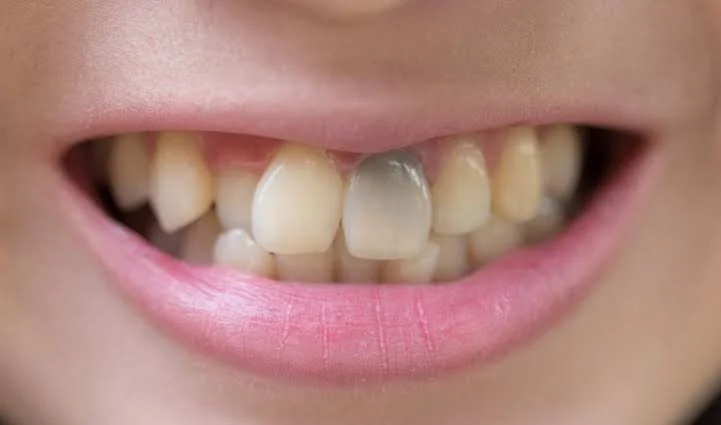
A common question among patients seeking non-vital aesthetic care is whether they can undergo internal tooth bleaching without root canal treatment.
From a strict biological and clinical standpoint: Internal tooth bleaching cannot be performed without a completed, high-quality root canal filling.
- Access Requirement: The procedure requires opening the pulp chamber. In a vital living tooth, doing so would sever the dental nerve, causing irreversible pulpitis and tooth death.
- Radicular Seal Necessity: In a non-vital tooth, the root canal filling must be hermetically sealed with gutta-percha and sealer before bleaching. Without an existing root canal filling, the oxidizing chemicals would travel down the root canal into the periapical bone, causing severe bone inflammation and acute apical periodontitis.
- Mandatory Protocol: If a dark tooth has become non-vital due to trauma but never received root canal therapy, an endodontist must first complete root canal treatment and place a cervical barrier before initiating internal bleaching.
What Are the Potential Internal Tooth Bleaching Side Effects and Pain Levels?
When evaluating treatment safety, understanding potential internal tooth bleaching side effects is essential for preventing structural complications. The most significant historical complication associated with intracoronal bleaching is external cervical root resorption.
- [ HYDROGEN PEROXIDE PENETRATION ]: Strong oxidizer leaks through open dentinal tubules at the neck
- [ CERVICAL LIGAMENT IRRITATION ]: Chemical irritation denatures protective cementum at gumline
- [ OSTEOCLASTIC ACTIVATION ]: Multinucleated clastic cells recruit, dissolving external root surface
To eliminate this risk, modern protocols mandate placing a 2.0 mm thick cervical barrier (using resin-modified glass ionomer or bioceramic material) over the root filling at the level of the cementoenamel junction before placing the bleach. This mechanical barrier blocks oxidizing agents from diffusing through the cervical dentinal tubules into the surrounding periodontal ligament.
Regarding internal tooth bleaching pain, the procedure is entirely painless during placement because the tooth is non-vital (it possesses no living nerve tissue). Patients rarely experience mild, temporary pressure or dull periodontal ligament aching for 24 to 48 hours as the oxidizing paste expands slightly inside the crown, which is easily managed with standard mild painkillers.
Visual & Structural Evaluation: Internal Tooth Bleaching Before After
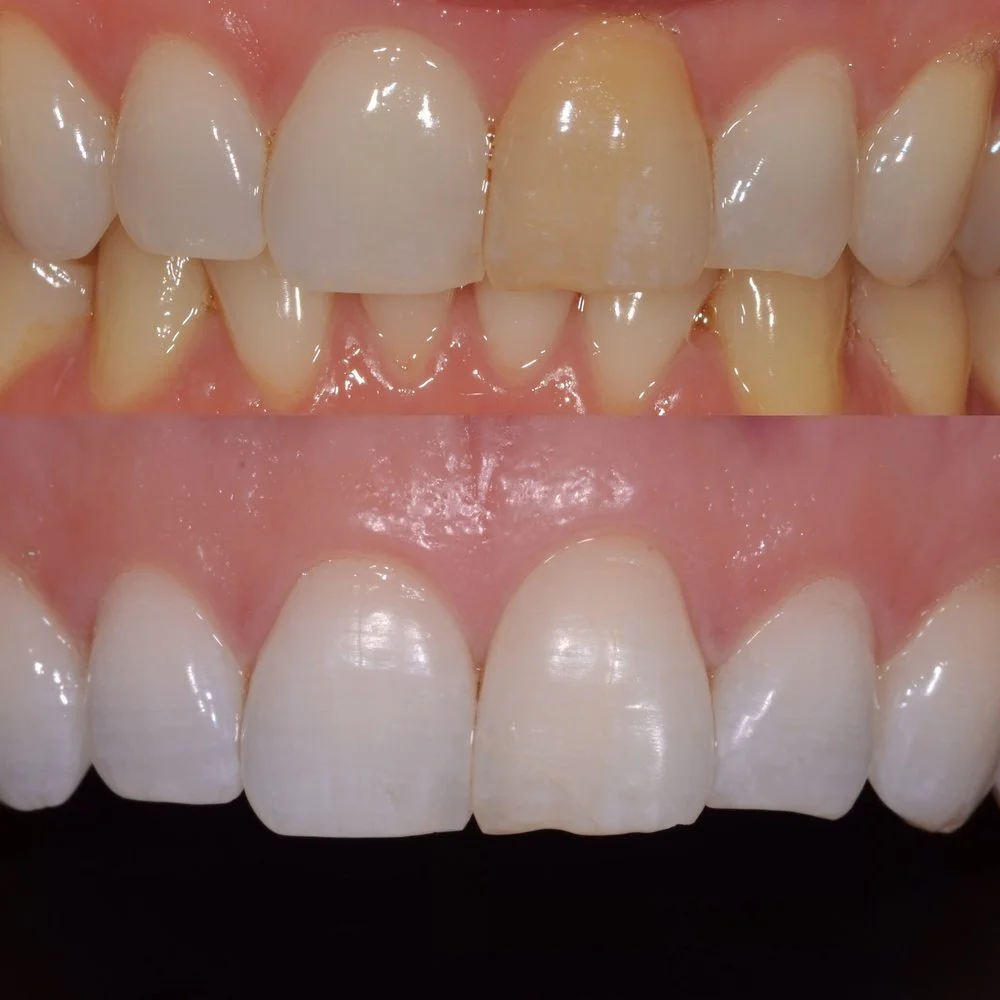
Reviewing clinical documentation in internal tooth bleaching before after cases illustrates how restoring intrinsic tooth shade rejuvenates smile symmetry without artificial crowns.
Clinical Parameter | Pre-Treatment Discolored State | Post-Bleaching Restored State |
Crown Shade & Value | Dark grey, brown, or purplish non-vital hue | Natural white matching adjacent vital teeth |
Enamel Preparation | Zero structural reduction; native enamel intact | 100% natural enamel preserved; no drilling |
Pulp Chamber Status | Trapped necrotic pigments inside dentin | Cleared dentinal tubules; sealed bioceramic base |
Gingival Margin Health | Intact cervical tissue; no thermal sensitivity | Healthy pink gums; zero root resorption risk |
When evaluating how long does internal tooth bleaching last, clinical studies demonstrate that over 80% of successfully treated teeth maintain their matched shade for 5 to 10+ years. If minor shade relapse occurs over time due to dietary stain absorption, a quick single-visit touch-up walking bleach session can easily restore ideal brightness.
Frequently Asked Questions
What is internal tooth bleaching compared to external tooth whitening?
Internal tooth bleaching involves placing an oxidizing agent inside the pulp chamber of a non-vital, root-canal-treated tooth to bleach intrinsic stains from the inside out. External tooth whitening applies peroxide gels to the outside enamel surfaces of living, vital teeth to remove external stains and lighten general enamel shade.
How many sessions does internal tooth bleaching take to work?
Most non-vital discolored teeth achieve an ideal shade match in 1 to 3 sessions. The oxidizing paste is sealed inside the tooth for 3 to 7 days per session, after which the dentist evaluates the shade, refreshes the paste if necessary, or permanently seals the access cavity once the desired brightness is reached.
Can internal tooth bleaching weaken the tooth structure?
Internal bleaching itself does not chemically dissolve or weaken healthy enamel or dentin. However, because non-vital teeth have already lost internal moisture and structural dentin from previous trauma or root canal access, the tooth must be permanently restored with a bonded composite resin core immediately after bleaching to reinforce its structural strength.
Why do root-canal-treated teeth turn dark in the first place?
Teeth turn dark after trauma or root canal therapy due to the breakdown of red blood cells (hemoglobin) within the pulp chamber, which releases iron pigments that penetrate deep into the microscopic dentinal tubules. Incomplete removal of pulp remnants or older root canal filling materials in the crown can also cause severe darkening over time.
What should I do if the bleached tooth becomes slightly darker after a few years?
If slight color regression occurs after several years, you do not need a crown or veneer. Your dentist can easily reopen the small lingual access cavity on the back of the tooth, place a fresh walking bleach paste for a few days to restore brightness, and reseal it with composite in a simple, non-invasive maintenance procedure.
About the Author